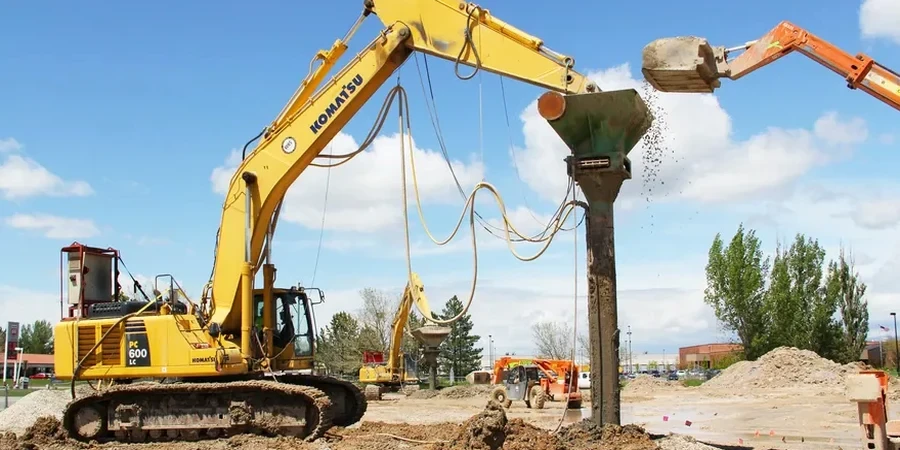
Little Rock sits at the transition between the Ouachita Mountains and the Mississippi Alluvial Plain, creating widely variable subsurface conditions. The IBC 2018 mandates that loose granular soils be improved before structural loads are applied, and that is where our vibrocompaction design process saves projects from costly over-excavation. We develop densification programs that target relative density increases above 70 percent. In areas near the Arkansas River where alluvial sands predominate, a properly designed vibrocompaction grid can eliminate differential settlement before the first footing is poured. The design phase integrates CPT soundings and grain size data to define probe spacing, vibration duration, and lift thickness.
Our lab operates under ASTM D1586 and ASTM D2487 protocols, ensuring the index properties used in the design are accurate. The Arkansas Geological Survey has mapped liquefiable deposits along the river corridor, and our designs account for this hazard directly. For sites where the sand fraction is borderline, we combine vibrocompaction analysis with a grain size evaluation to verify that fines content stays below 15 percent, which is critical for the technique to work.
A well-designed vibrocompaction program turns loose river sand into a competent bearing layer without importing a single ton of aggregate.