GEOTECHNICAL ENGINEERING
LITTLE ROCK
HomeIn-Situ TestingField density test (sand cone method)

Field Density Testing in Little Rock – Sand Cone Method for Reliable Compaction Control

Technical studies that support your project.

LEARN MORE

Little Rock sits on the south bank of the Arkansas River, where the alluvial soils switch from sandy loam to fat clay within a few hundred feet. That subsurface variability is exactly why the sand cone method remains the go-to density test here—it gives you a direct reading, no calibration against nuclear sources, no interference from the iron-rich lateritic gravels that show up in the western part of the county. In our experience across Pulaski County, a test pit logged at the start of the job saves hours of head-scratching when the compaction numbers come back unexpected. We run the ASTM D1556 procedure with graded Ottawa sand that we oven-dry on site before each series, and we verify the calibration cone at morning and afternoon breaks to stay within 1% of the initial volume. For pavement subgrades along I-430 or commercial pads near the Port of Little Rock, the combination of a well-documented sand cone test and a companion CBR field test gives the geotech engineer what they actually need: a compaction curve that matches the Proctor and a bearing capacity number the structural team can stamp.

A sand cone test gives you one number: in-place density. But paired with a Proctor and a good soil log, it tells you whether the compactor, the moisture, and the lift thickness are working together.
Our service areas

Process and scope

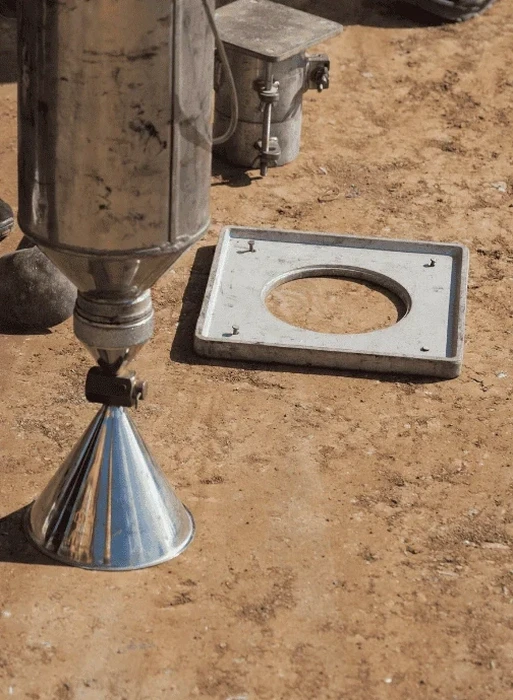
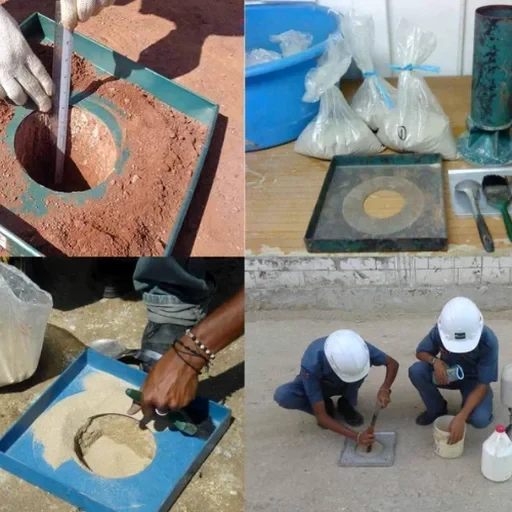
Little Rock's elevation ranges from about 260 feet at the riverfront to over 600 feet in the Chenal Valley hills—and the compaction behavior shifts with it. Upland sites on weathered shale of the Atoka Formation will give you Proctor maximums around 115 to 122 pcf at 12 to 15 percent optimum moisture, while the river-bottom silts near the Clinton Presidential Park can run 108 to 112 pcf optimum with a much narrower moisture window. We test both scenarios with the same ASTM D1556 sand cone setup, but the approach changes: on the shales we're watching for oversized particles that can skew the hole-volume measurement, and on the silts we're rushing to get the rubber-base template seated before the hole walls collapse. The method itself is straightforward—excavate a test hole, capture every gram of removed soil, flow calibrated sand from a pre-weighed apparatus into the cavity, and back-calculate the in-place wet density—but the judgment calls come from running hundreds of these tests across Little Rock's microclimates. For projects where the fill lifts are too thin for the sand cone's minimum hole depth, we'll sometimes cross-check with a plate load test to get a direct modulus reading on the compacted surface.
Field Density Testing in Little Rock – Sand Cone Method for Reliable Compaction Control
Technical reference — Little Rock

Local considerations

The biggest compaction failure we see in Central Arkansas isn't the test method—it's moisture conditioning. The local geology alternates between Pleistocene terrace deposits and the Jackson Group clays, and the Jackson clays in particular will swell and lose density fast if they get rained on after grading. We've measured density drops of 8 to 12 pcf between a Friday afternoon test and a Monday morning recheck on a Little Rock school site after a weekend thunderstorm. That's a failed lift and a day of rework. The sand cone method catches this because you're weighing the excavated material directly, and the field moisture content from a speedy or oven-dry sample tells you immediately whether you're on the wet side of the Proctor curve. In trench backfill along Cantrell Road, where the water table can sit just six feet down, we recommend pairing the density test with an in-situ permeability check to confirm the compacted clay liner is actually meeting the 1×10⁻⁷ cm/s spec—density alone won't guarantee hydraulic performance in those conditions.

Need a geotechnical assessment?

Reply within 24h.

Email: [email protected]

Regulatory framework

ASTM D1556 – Standard Test Method for Density and Unit Weight of Soil in Place by the Sand-Cone Method, ASTM D698 / D1557 – Standard Test Methods for Laboratory Compaction Characteristics (Standard and Modified Proctor), ASTM D2216 – Standard Test Methods for Laboratory Determination of Water (Moisture) Content of Soil and Rock, IBC 2024 Section 1805 – Compaction requirements for structural fill

Technical parameters

ParameterTypical value
Test standardASTM D1556 / AASHTO T 191
Calibration sand typeGraded Ottawa sand (C-109 or equivalent)
Minimum test hole volume≥ 6× maximum particle size in soil
Typical hole depth range4 to 7 inches (for ≤ 2-inch lift aggregate)
Field moisture correlationSpeedy moisture tester (ASTM D4944) or oven-dry per ASTM D2216
Reported resultWet density (pcf), dry density (pcf), and % compaction vs Proctor
Applicable soil typesSands, silts, lean clays; not for open-graded gravels with large voids

Common questions

How does the sand cone method compare to a nuclear density gauge for compaction testing?

The sand cone method per ASTM D1556 is a direct measurement—you physically excavate the soil, weigh it, and measure the hole volume with calibrated sand. A nuclear gauge infers density from gamma radiation backscatter. In Little Rock's iron-rich residual soils and areas with lateritic gravels, the nuclear gauge can give biased readings due to the mineralogy, while the sand cone result is independent of soil chemistry. The trade-off is speed: a sand cone test takes 15 to 20 minutes per point versus a minute or two for a nuclear gauge, but for acceptance testing where the result is binding, the direct method eliminates arguments about calibration offsets.

What does field density testing with the sand cone method cost in the Little Rock area?

For projects in Little Rock and surrounding Pulaski County, a single sand cone density test typically runs between US$110 and US$140 per point, depending on mobilization distance and the number of tests per day. That price includes the field test, the moisture content determination, and the percent compaction calculation against the project's Proctor curve, with results reported within 24 hours.

What soil conditions in Central Arkansas can cause a sand cone test to fail or give unreliable results?

Three conditions in the Little Rock area give us trouble. First, saturated silts below the water table near the Arkansas River will collapse the test hole before you can get the sand poured, and you'll need to stabilize with a casing or switch methods. Second, soils with significant gravel or chert fragments larger than about 1.5 inches can create voids around the excavated hole that the calibration sand fills, overestimating the volume and underestimating density. Third, the expansive Jackson Group clays in West Little Rock can shrink and crack within hours of compaction in dry weather, so the density you measure at 10 a.m. may not represent the condition by 3 p.m.—timing matters.

Location and service area

We serve projects in Little Rock and surrounding areas.

View larger map