GEOTECHNICAL ENGINEERING
LITTLE ROCK
HomeSlopes & WallsActive/passive anchor design

Active & Passive Anchor Design in Little Rock, AR

Technical studies that support your project.

LEARN MORE

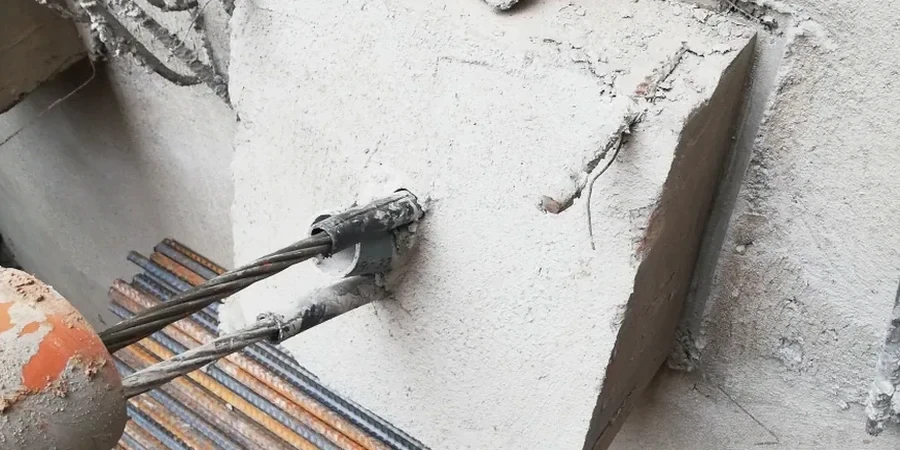
Anchor design in Little Rock must respond to the IBC 2021 and ASCE 7-22 provisions, but the real engineering challenge is the local shale. The Jackfork Formation underlies much of the metro area—heavily fractured, blocky, and highly anisotropic. We see a lot of projects where passive anchors fail because bond length was estimated from generic rock tables instead of field pull-out data. Our team runs tension tests on sacrificial anchors before finalizing the production design. This verification step avoids over-design in good rock, and catches weak zones that standard correlations miss. In the Riverdale area especially, where the Arkansas River cuts close to steep bluffs, active anchors in permanent walls need corrosion protection Class II per PTI DC35.1. We also combine anchor systems with slope stability analysis when the failure plane runs deep through weathered shale benches, and with retaining walls design for tieback soldier pile walls along I-630 corridor cuts.

A load test on a sacrificial anchor costs less than re-mobilizing a drill rig after a bond failure during production stressing.
Our service areas

Process and scope

One thing only a local engineer would point out: in west Little Rock, near the Chenal Valley developments, the shale bedrock is often capped by 8 to 15 feet of stiff fat clay. That clay layer dictates the unbonded length. We’ve seen designs where the unbonded segment was too short, putting the bond zone inside the active wedge—the anchor loses tension within the first wet season. For active anchors we specify a minimum unbonded length that extends past the critical failure surface plus a safety buffer of 5 feet or H/5, whichever is larger. Passive anchors—often used in rock dowels for benched cuts—work differently: they mobilize resistance through deformation, so we size them for service limit state displacement, not just ultimate pullout. We test to ASTM D4435 for rock bolts and D3689 for strand anchors. Corrosion potential is moderate to high because of seasonal groundwater perched above the shale, so double-corrosion protection is standard on permanent installations. Production testing runs to 133% of design load per PTI recommendations. We log every anchor with installation torque, grout take, and water pressure readings to catch anomalies before stressing.
Active & Passive Anchor Design in Little Rock, AR
Technical reference — Little Rock

Local considerations

A 15-story tower project near the Statehouse Convention Center excavated a 28-foot-deep basement adjacent to an existing parking structure. The shoring designer called for 5-strand active tiebacks at 8-foot spacing. First two production anchors failed proof testing at 60% of design load. The cause: bond zone placed entirely in a 3-foot-thick bentonite seam within the shale that wasn’t caught by the single exploration boring. We redesigned the anchor field using inclined bond zones that punched through the seam into competent rock below, verified by probe drilling at every anchor location. The fix took three extra days but prevented a shoring collapse that would have threatened the adjacent building. In Little Rock, the shale is just too variable to trust a desk study alone. Every critical anchor project needs pre-production testing. Skipping that step is gambling with the excavation stability.

Need a geotechnical assessment?

Reply within 24h.

Email: [email protected]

Regulatory framework

IBC 2021 Chapter 18 (Soils and Foundations), ASCE 7-22 Minimum Design Loads, PTI DC35.1-14 (Recommendations for Prestressed Rock and Soil Anchors), FHWA GEC No.4 Ground Anchors and Anchored Systems, ASTM D4435 (Rock Bolt Anchor Pull Test), ASTM A416 (Low-Relaxation Seven-Wire Steel Strand)

Technical parameters

ParameterTypical value
Anchor typeActive (prestressed strand) / Passive (fully grouted bar)
Design standardPTI DC35.1-14, FHWA GEC No.4, IBC 2021
Rock socket bond stress (shale)50-150 psi (verified by field pull-out test)
Unbonded length minimum5 ft or H/5 beyond failure plane
Test load (production)133% of design lock-off load
Corrosion protection (permanent)Class II, double encapsulation per PTI
Free length stressing tolerance±5% of theoretical elongation

Common questions

How much does anchor design cost in Little Rock?

Anchor design fees in the Little Rock metro area range from US$1,100 to US$3,400 depending on the number of anchors, wall height, and whether pre-production testing is required. A typical shoring wall with 30-50 tiebacks falls in the mid-range.

What is the difference between active and passive anchors?

Active anchors are prestressed after grouting—we apply a lock-off load that actively compresses the retained soil or rock mass. Passive anchors develop resistance only when the ground deforms; they are typically fully grouted bars used as rock dowels in cuts where some displacement is tolerable.

Does Little Rock shale require special anchor design?

Yes. The Jackfork Formation shale is fractured and anisotropic. Bond stress values from generic tables are unreliable. We always recommend at least two sacrificial pull-out tests per wall alignment to confirm the actual bond capacity in situ before sizing production anchors.

What corrosion protection do permanent anchors need?

Permanent anchors in Little Rock require Class II double-corrosion protection per PTI DC35.1. This means each strand is individually encapsulated with grease and a plastic sheath over the full bond and unbonded length, plus an outer corrugated duct grouted in place. The perched groundwater in the shale makes this mandatory.

How is anchor spacing determined?

Spacing is a function of soil/rock strength, anchor capacity, and wall type. In shale, we typically use 6- to 8-foot horizontal spacing for soldier pile walls with active tiebacks. Closer spacing increases cost and can cause group effects; wider spacing increases bending moments in the wall. We optimize spacing during the design phase using FHWA GEC No. 4 guidelines.

Location and service area

We serve projects in Little Rock and surrounding areas.

View larger map