GEOTECHNICAL ENGINEERING
LITTLE ROCK
HomeSeismicSoil liquefaction analysis

Soil Liquefaction Analysis in Little Rock: Seismic Ground Failure Assessment

Technical studies that support your project.

LEARN MORE

A four-story mixed-use structure near the Arkansas River overbank deposits in downtown Little Rock was on hold until the geotechnical report resolved a critical question: could the saturated fine sands at 18 feet trigger a flow failure during a design-level earthquake. The owner needed a clear yes or no before the foundation contractor would mobilize. Our team ran a liquefaction triggering analysis using Seed-Idriss simplified procedure, corrected SPT N-values for overburden and fines content, then computed the factor of safety against liquefaction at three critical layers. The answer was no for static conditions, but a marginal factor of safety at one lens meant ground improvement with stone columns became the recommended mitigation. In a city where the New Madrid seismic zone influences design ground motions, skipping this step is not an option.

A factor of safety below 1.1 in any liquefiable layer demands either ground improvement or a foundation system that bypasses the critical zone entirely.
Our service areas

Process and scope

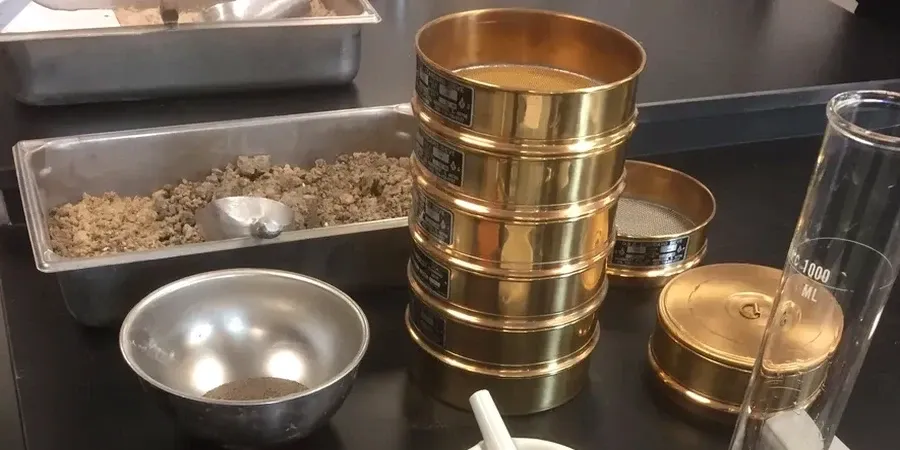
Little Rock sits on the boundary between the Western Gulf Coastal Plain and the Ouachita Mountains, a geologic transition that produces highly variable subsurface conditions across short distances. The Quaternary alluvium along the Arkansas River corridor contains loose, saturated sands with SPT blow counts as low as 4 to 8, exactly the type of deposit that liquefaction susceptibility screening per ASTM D2487 is designed to flag. We combine field data from CPT testing with laboratory cyclic triaxial tests to determine the cyclic resistance ratio (CRR) and compare it against the cyclic stress ratio (CSR) computed from the site-specific peak ground acceleration. The analysis incorporates magnitude scaling factors for the New Madrid source, depth to groundwater measured at the time of drilling, and total and effective overburden stresses at each sublayer. Fines content corrections follow the updated Boulanger-Idriss (2014) framework adopted in ASCE 7-22 Chapter 21 for liquefaction assessment. Our reports include a layer-by-layer factor of safety table, post-liquefaction settlement estimates, and a clear statement on whether the site is acceptable without ground treatment.
Soil Liquefaction Analysis in Little Rock: Seismic Ground Failure Assessment
Technical reference — Little Rock

Local considerations

Little Rock's development history along the Arkansas River floodplain means many commercial parcels sit on recent alluvium that never experienced pre-construction densification. The New Madrid seismic zone, while centered northeast of the city, still imposes design ground motions capable of triggering liquefaction in susceptible soils. Post-liquefaction settlements of 2 to 6 inches are not theoretical here — they have been predicted by our analyses for sites with loose sands thicker than 10 feet. The consequence is differential settlement that cracks slabs, tilts shallow footings, and can rupture utility lines. Lateral spreading toward the river channel is an additional hazard for any structure within 500 feet of the bank. The IBC requires a site-specific liquefaction study when the groundwater table is within 50 feet of grade and the mapped spectral acceleration exceeds 0.10g, conditions met across much of the Little Rock metro area.

Need a geotechnical assessment?

Reply within 24h.

Email: [email protected]

Regulatory framework

ASCE 7-22 Chapter 21 (Site-Specific Ground Motion Procedures and Liquefaction Assessment), IBC 2021 Section 1803.5.12 (Liquefaction Potential Evaluation), ASTM D1586-18 (Standard Penetration Test and Split-Barrel Sampling of Soils), ASTM D2487-17 (Classification of Soils for Engineering Purposes — USCS), ASTM D6066-11 (Determination of the Normalized Penetration Resistance of Sands for Liquefaction Assessment)

Technical parameters

ParameterTypical value
Corrected SPT N-value (N1)60cs4 to 14 blows/ft in critical layers
Fines content (FC)5% to 35% (determines correction path)
Peak ground acceleration (PGA)0.15g to 0.25g per USGS hazard maps
Depth to groundwater6 to 18 ft (seasonal fluctuation applied)
Cyclic stress ratio (CSR)0.18 to 0.42 at design earthquake
Cyclic resistance ratio (CRR)0.10 to 0.38 from SPT/CPT correlations
Magnitude scaling factor (MSF)1.0 to 1.4 for M7.5 reference

Common questions

What does a soil liquefaction analysis cost for a typical commercial lot in Little Rock?

For a standard commercial parcel in the Little Rock metro area, a complete liquefaction analysis including SPT drilling, laboratory fines content testing, and the full triggering report runs between US$2,610 and US$4,320. The range depends on the number of borings required, the depth of the critical liquefiable layer, and whether CPT soundings are added to complement the SPT data. Projects near the Arkansas River floodplain sometimes need deeper investigation, which moves cost toward the upper end.

At what depth does liquefaction risk become negligible in the Little Rock area?

Liquefaction is generally confined to the upper 50 feet of saturated, loose granular soils. In the Arkansas River alluvium beneath Little Rock, the critical zone is typically between 10 and 35 feet. Below 50 feet, overburden pressure usually increases the cyclic resistance ratio enough to eliminate concern, but this must be verified with SPT or CPT data at the specific site. The IBC threshold of 50 feet to groundwater is the screening trigger, not a safety guarantee.

How does the New Madrid seismic zone affect liquefaction design in Little Rock?

The New Madrid seismic zone, approximately 150 miles northeast of Little Rock, produces long-period ground motions that can propagate significant energy into the Mississippi Embayment sediments. For Little Rock sites, the USGS probabilistic ground motion maps assign a peak ground acceleration of 0.15g to 0.25g at the 2,475-year return period. These accelerations, combined with the magnitude scaling factor for a M7.5 to M8.0 event, produce cyclic stress ratios that frequently exceed the cyclic resistance of loose Arkansas River sands, making liquefaction analysis mandatory under IBC 2021 Section 1803.5.12.

Can you use existing SPT data from a previous geotechnical report for liquefaction analysis?

We can use existing SPT data if the borings were logged within the last five years, the groundwater depth was measured at the time of drilling, and the split-spoon samples were taken with a calibrated hammer per ASTM D1586. Older data or borings without contemporaneous groundwater readings often produce misleading (N1)60 values because energy correction factors are unknown. For most Little Rock projects, we recommend at least one new boring to establish a baseline correction factor before relying on historical logs.

Location and service area

We serve projects in Little Rock and surrounding areas.

View larger map