GEOTECHNICAL ENGINEERING
LITTLE ROCK
HomeGeophysicsElectrical resistivity / VES (Vertical Electrical Sounding)

Electrical Resistivity & VES Surveys for Accurate Subsurface Profiling in Little Rock

Technical studies that support your project.

LEARN MORE

In Little Rock, where the Arkansas River Valley geology introduces sharp transitions between alluvial deposits and the underlying Paleozoic bedrock, electrical resistivity surveys provide a critical non-invasive method for mapping subsurface conditions before any excavation begins. The IBC and local amendments require a clear understanding of soil-rock interfaces, especially in areas near the river where soft clays and sands overlie weathered shale and limestone. Our team runs Vertical Electrical Sounding (VES) following ASTM D6431 protocols, injecting a controlled current into the ground to measure apparent resistivity variations with depth. This technique allows us to detect buried channels, variable water tables, and potential karst features in the limestone, which are common in Pulaski County and can significantly impact foundation design. Combining resistivity data with targeted test pits helps calibrate the geophysical model against physical samples, ensuring the final interpretation aligns with the actual stratigraphy observed in Little Rock's complex terrain.

A single VES sounding in Little Rock's river valley can map the soil-rock interface to depths of 100 feet without turning a single shovel, saving weeks of investigation time.
Our service areas

Process and scope

Little Rock's development history, from its founding on the banks of the Arkansas River to its expansion westward into the foothills of the Ouachita Mountains, means that geotechnical conditions can vary dramatically within a single project site. The older downtown districts often sit on layers of historical fill mixed with natural alluvium, while newer subdivisions to the west encounter residual soils formed from the weathering of Jackfork Sandstone and Stanley Shale. In our experience, a four-electrode Wenner or Schlumberger array deployed across these terrains reveals the lateral extent of fill zones and the depth to competent rock far more efficiently than a grid of boreholes alone. When the resistivity profile indicates a sudden drop in values, it typically points to a water-saturated clay layer or a groundwater table perched within the fill, information that is essential when planning deep excavations or designing dewatering systems for a project in central Arkansas.
Electrical Resistivity & VES Surveys for Accurate Subsurface Profiling in Little Rock
Technical reference — Little Rock

Local considerations

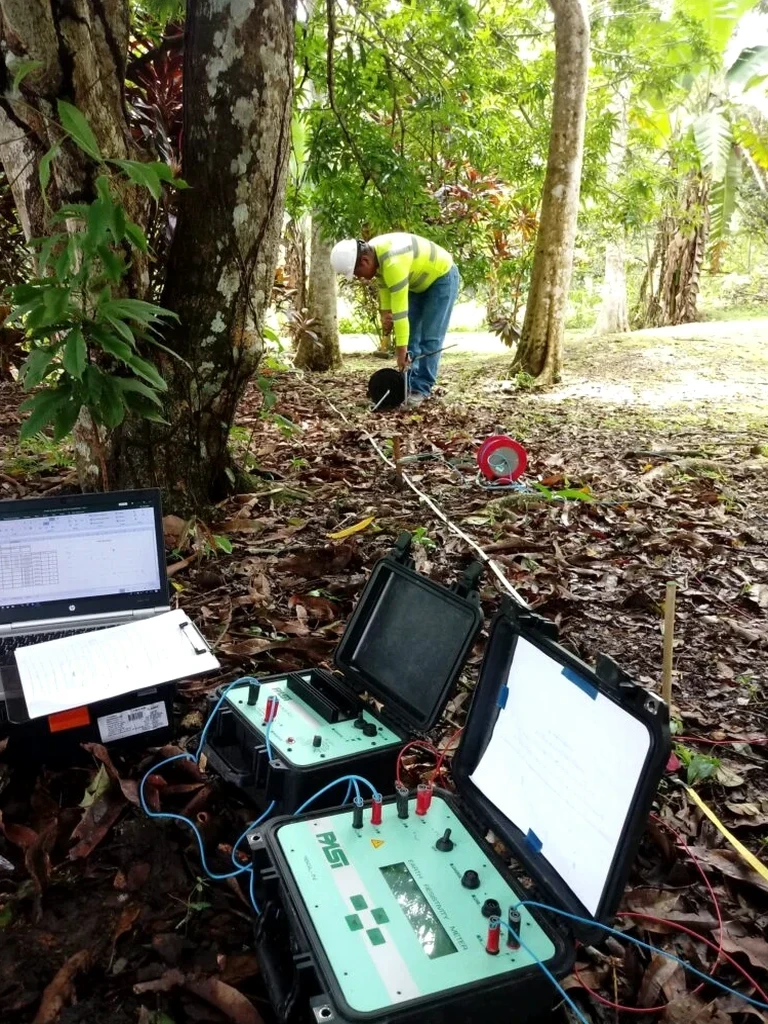
We deploy a multi-electrode resistivity system with 28 to 56 stainless steel electrodes connected via a reinforced cable, which allows us to switch between Wenner and Schlumberger arrays without physically moving the stakes. In a recent project near the Little Rock Port, we set up a 400-foot line across a site where a contractor suspected buried debris from an old barge terminal. The equipment injected a regulated current up to 500 mA while the built-in GPS logged each electrode position, and within two hours we had a clear 2D profile showing a distinct low-resistivity anomaly at 15 feet depth. The biggest risk in central Arkansas is misinterpreting a saturated clay lens as a bedrock surface, which happens when resistivity surveys are run without calibration against at least one boring. A false low in the data can lead a designer to assume shallow rock for footings, only to discover compressible soils during excavation, which triggers costly change orders and delays the entire construction schedule.

Need a geotechnical assessment?

Reply within 24h.

Email: [email protected]

Regulatory framework

ASTM D6431-18 Standard Guide for Using the Direct Current Resistivity Method for Subsurface Site Characterization, IBC 2021 (Arkansas adoption) — Section 1803 Geotechnical Investigations, ASCE 7-22 — Minimum Design Loads for Buildings and Other Structures

Technical parameters

ParameterTypical value
Test StandardASTM D6431-18
Electrode Arrays UsedWenner, Schlumberger, Dipole-Dipole
Investigation Depth Range3 to 200 feet (1 to 60+ meters)
Data Acquisition SystemMulti-electrode resistivity meter with automatic stacking
Output ParameterApparent resistivity (ohm-m), interpreted true resistivity sections
Typical Line Length100 to 800 feet per spread
Reporting Format2D inverted resistivity cross-sections and VES curve models

Common questions

What is the typical cost of an electrical resistivity survey in Little Rock?

In Little Rock, a standard VES survey or a short 2D ERT line generally ranges from US$590 to US$950, depending on the depth of investigation required and the number of soundings. Larger projects requiring multiple long lines or complex terrain along the Arkansas River bluffs will be priced on a case-by-case basis after our team reviews the site layout.

How does the VES method work in practice?

The technique uses four electrodes driven into the ground: two outer electrodes inject a measured direct current, and two inner electrodes measure the resulting potential difference. By progressively increasing the spacing between the current electrodes, we force the current to flow deeper, and the measured apparent resistivity is plotted against electrode spacing to generate a layered model of true subsurface resistivity.

Can resistivity surveys detect sinkholes or karst features in the limestone beneath Little Rock?

Yes, electrical resistivity is highly sensitive to air-filled or clay-filled voids within limestone. A void shows up as a sharp high-resistivity anomaly if dry, or a low-resistivity zone if water-saturated. We routinely run closely spaced ERT lines in areas of Pulaski County where the Boone Formation limestone is near the surface to map potential subsidence risks.

How long does a field survey take, and what access do you need?

A single VES sounding can be completed in about 30 to 45 minutes, while a 400-foot 2D ERT line typically takes two to three hours with a two-person crew. We need a clear, relatively straight transect free of buried metallic utilities that could distort the current field, and we handle the Little Rock 811 utility locate coordination as part of the survey planning.

Location and service area

We serve projects in Little Rock and surrounding areas.

View larger map