GEOTECHNICAL ENGINEERING
LITTLE ROCK
HomeLaboratoryGrain size analysis (sieve + hydrometer)

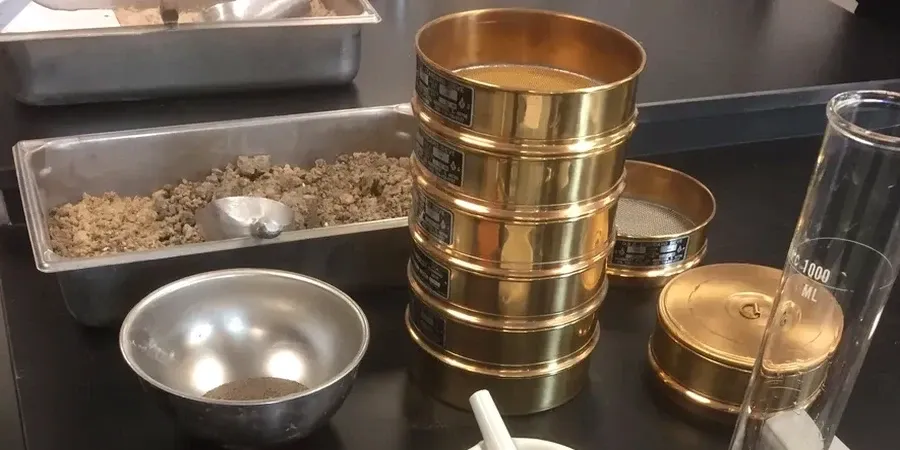
Grain Size Analysis in Little Rock: Sieve & Hydrometer Testing

Technical studies that support your project.

LEARN MORE

Little Rock soil tells two different stories. West of I-430, you hit residual clays weathered from the Jackfork Formation. East toward the Arkansas River, recent alluvial deposits dominate. The grain size distribution dictates whether you can compact fill effectively or need to design for expansive behavior. A standard proctor test means little without the particle breakdown behind it. For any project near the McClellan-Kerr waterway, we combine sieve analysis with hydrometer readings to catch the silt fraction that leads to differential settlement. This data shapes your foundation design long before concrete hits the ground. We deliver ASTM D2487 classifications from our accredited lab, ensuring every soil description ties back to a measured curve, not a visual guess. When a test pit exposes layered strata, we sample each horizon separately because mixing them masks the weak layer that actually controls stability.

A sieve curve without the hydrometer tail misses the 10% of fines that cause 90% of subgrade failures in central Arkansas.
Our service areas

Process and scope

Sandy Point and Hillcrest might be three miles apart, but their subgrades behave nothing alike. We see contractors surprised when a borrow source passes the sieve check but fails the hydrometer. That fine fraction below the #200 sieve controls drainage and frost susceptibility. Our process runs from coarse separation on the 3-inch sieve down through the 75-micron hydrometer range. We report D10, D30, D60, coefficient of uniformity, and curvature. For road base acceptance under ARDOT standards, the gradation band is tight. We run the wash sieve analysis first because skipping it inflates your sand equivalent and hides plastic fines. Every report includes the particle size distribution curve overlaid against specification envelopes so the project engineer can see compliance at a glance. We batch samples daily from our Little Rock lab, which keeps turnaround under 48 hours for standard sets.
Grain Size Analysis in Little Rock: Sieve & Hydrometer Testing
Technical reference — Little Rock

Local considerations

The Arkansas River floodplain holds interbedded silts and clays that look uniform from the surface but grade sharply within two vertical feet. We sampled a site off Springer Boulevard last spring where the upper three feet classified as SM (silty sand). At five feet, the material flipped to CL (lean clay) with 92% passing the #200 sieve. The geotechnical report had recommended a spread footing bearing pressure based on the upper layer alone. The grain size data from the deeper hydrometer run changed the foundation recommendation to a stiffened mat with undercut. In Little Rock's seismic zone, per ASCE 7, fine-grained soils with high uniformity coefficients also raise liquefaction screening flags. A grain size curve is not a commodity test. Interpreted correctly, it saves the owner from a floor slab that heaves and a retaining wall that retains water instead of draining it.

Need a geotechnical assessment?

Reply within 24h.

Email: [email protected]

Regulatory framework

ASTM D6913-04: Standard Test Methods for Particle-Size Distribution of Soils (Sieve), ASTM D7928-21: Standard Test Method for Particle-Size Distribution of Fine-Grained Soils (Hydrometer), ASTM D2487-17: Standard Practice for Classification of Soils for Engineering Purposes (USCS), ASCE 7-22: Minimum Design Loads (Seismic site class determination)

Technical parameters

ParameterTypical value
Test MethodASTM D6913 (sieve) + ASTM D7928 (hydrometer)
Sieve Range3 in to No. 200 (75 mm to 75 μm)
Hydrometer Type152H, with sodium hexametaphosphate dispersion
Reported ParametersD10, D30, D60, Cu, Cc, % gravel, sand, silt, clay
Soil ClassificationUSCS per ASTM D2487, AASHTO M 145
Sample MassMinimum 500 g for fine-grained; 5 kg for granular
Turnaround24-48 hours standard; same-day expedited available

Common questions

How much does a grain size analysis cost in Little Rock?

A complete sieve plus hydrometer package typically runs between US$80 and US$170 per sample, depending on whether you need the full hydrometer sedimentation or just the wash sieve. Volume discounts apply for borrow source programs with five or more samples per submittal.

How long does the hydrometer portion take?

The hydrometer sedimentation reading spans a minimum of 24 hours because we need to capture the fine clay fraction settling over time. Combined with the sieve analysis, most reports leave our lab within 48 hours of sample receipt.

Do I need the hydrometer if my material looks sandy?

Almost always yes in central Arkansas. Many SM and SC soils carry enough silt and clay to affect drainage and frost heave potential. The hydrometer quantifies that fine tail. Without it, you are classifying based on the sand fraction alone, which can misrepresent the material's actual engineering behavior.

What sample size do you need for the full analysis?

We require a minimum of 500 grams for fine-grained soils and five kilograms for granular materials with gravel. Samples should be sealed in a plastic bag immediately after extraction to preserve natural moisture. We can accept disturbed samples from test pits or split-spoon samplers.

Location and service area

We serve projects in Little Rock and surrounding areas.

View larger map